Science-backed AI skin analysis should mean one practical thing for a beauty brand: the vendor can show you how its results were built and checked, not just tell you they're good. Ask who labelled the training images, which skin tones, ages and lighting the data covers, how the model's output was compared with those labels, and how stable a result is when the same face is scanned twice. If a vendor answers those clearly, the "science" label means something. If all you get is a percentage on a landing page, it doesn't.
I've sat through enough beauty-tech demos to know the pattern. The slides say "dermatologist-developed" and "validated", the demo face is perfectly lit, and the scan looks brilliant. Then you put it on a real store and real shoppers take selfies in a dim hallway. This guide is the list of questions I'd send before that happens. It applies to every vendor, Face Age included.
Why science-backed AI skin analysis is hard to judge
Most beauty brands buying skin analysis aren't data scientists, and vendors know it. So the claims drift toward words that sound rigorous but can't be checked: proprietary, validated, expert-trained, "lab-grade". Some of those may be true. None of them is evidence on its own.
There's also a mismatch in what's being measured. A vendor might prove its model agrees with expert graders on a curated dataset. That's useful. It doesn't prove the result is stable on a shopper's phone in mixed light, or that the product suggestions that follow make sense. You need evidence for both parts: the analysis and what your store does with it.
The five questions that matter
1. Who labelled the ground truth?
A skin model learns from images that humans have graded, for example "moderate redness on the cheeks". The quality of those labels sets the ceiling for everything else.
Ask: how many graders per image, what training they had, and how disagreements between graders were handled. If two experts often disagree on a concern, the model can't be more reliable than that agreement. A vendor that knows its inter-grader agreement figures is a vendor that's done the work.
2. What does the dataset cover?
Ask for the spread, not the total. Ten thousand images of one skin-tone group under studio light are less useful to you than a smaller set that covers your actual customers.
Specifically: Fitzpatrick or Monk skin-tone groups, age bands, sex, and capture conditions (phone selfies vs studio photos, daylight vs indoor). Some vendors publish this openly now, which is a good sign. If yours serves a market with many darker skin tones, ask for results broken down by tone group, not averaged.
3. How was the output checked?
"We validated it" should come with a method. Was the model tested on images it never saw in training? Which metric was used, and for which concerns? Did the vendor run the test, or someone independent?
Vendor-run benchmarks aren't worthless. One large vendor now publishes a benchmark comparing its model with general-purpose AI models against expert labels, with the scoring method written out. That's more transparent than most. Still, read the method before you read the leaderboard, and remember who designed the test.
4. Is the result repeatable?
This is the one store owners can check themselves, and it matters most day to day. Scan the same person three times in a row in the same light. Then once in different light. A good analyzer gives close readings. A shaky one swings from "mild" to "strong" between shots, and shoppers notice when they rescan.
Our guide to testing a skin analyzer before you trust it has a step-by-step version of this test.
5. What's the intended use?
Ask the vendor to state, in writing, what the analysis is for. For a cosmetics store the answer should be: helping shoppers understand visible skin concerns and choose products. If the vendor's own marketing uses medical language, ask yourself if you want that next to your products. Your result page needs to stay clearly cosmetic.
Evidence for the recommendations, not just the scan
Here's where many evaluations stop too early. A good analysis that feeds poor product logic still gives shoppers poor suggestions.
Ask how scan results become products. Is it rules you control, a model you can't see, or both? Can you test the logic before it goes live? Can you exclude products for certain profiles, like rich oils for acne-prone results or strong actives for redness?
Then test it the boring way. Build a grid of profiles across ages, skin tones and concerns and check what each one gets recommended. Our walkthrough on validating AI skincare recommendations across ages, skin tones and skin concerns has a template.
Red flags in vendor claims
A few things make me slow down:
- A single headline accuracy number with no method. Ask for the test set, the metric and who ran it.
- Sales lift figures presented as proof the science works. Conversion depends on traffic, catalog and placement. It says little about whether the readings are right.
- "Detects" lists that include medical conditions. Not appropriate for a cosmetic store.
- No answer on skin tones. If they haven't broken results down by tone group, assume they haven't checked.
- Demo only on a vendor-chosen face. Insist on scanning your own team.
How Face Age answers these questions
Fair's fair, so here's how we approach it.
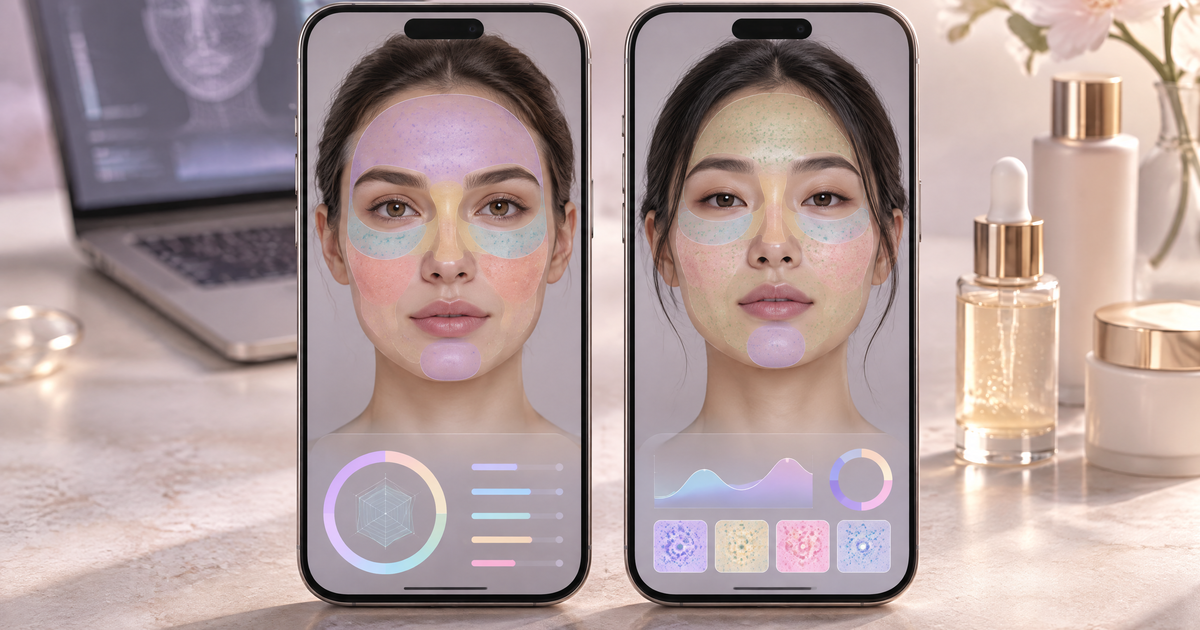
Face Age reads 13 visible concerns from one selfie, including fine and deep wrinkles, dark circles, pores, pigment, redness, oiliness and acne, across 250+ underlying attributes, plus Skin Age and Skin Health scores. Three concerns, dryness, sagginess and dullness, are labelled beta, and we say so to store teams. The full list with definitions is in our glossary of 13 skin concerns and 250+ attributes.
The analysis is cosmetic and informational. Not a medical diagnosis; does not replace a dermatologist. That line appears in the product, and we suggest stores keep it on the result page.
On the recommendation side, you control the logic. Each product is mapped to concerns with severity bands and exclusions, so you can see exactly why a shopper got a serum. You can test it yourself during the 7-day trial: scan your team, rescan in different light, and check the matches. The AI skin analysis feature page shows the result screen, and the live demo lets you try a scan on your own face.
We don't publish accuracy or sales-lift percentages on this blog. If you want to compare evidence across vendors, start with the same five questions for each. Our comparison of Haut.AI vs Thea Care vs Face Age shows what two vendors publish today.
A one-page evidence request you can send
Copy this into an email to any vendor:
- Who labelled your training images, how many graders per image, and how were disagreements resolved?
- Break down your dataset by skin-tone group, age band and capture condition.
- Which concerns were tested on held-out images, with which metric, and who ran the test?
- How stable are readings when the same face is scanned twice in the same light?
- What is the stated intended use of the analysis?
- How do scan results map to our products, and can we test and edit that logic before launch?
- Where are photos processed and stored, and for how long?
A vendor that answers all seven in plain language is one you can work with. One that sends a brochure instead has told you something too.
If you're still building a shortlist, the 2026 roundup of AI skin analysis tools for ecommerce stores is a good place to start. And once it's live, think about how shoppers read your claims: our piece on consumer trust in AI skin analysis covers what to show before, during and after the scan.
FAQ
What does science-backed AI skin analysis mean? The vendor can show who labelled the training images, what skin tones and lighting the data covers, how results were checked against those labels, and how stable a repeat scan is.
Is a high accuracy percentage on a vendor site enough? No. Ask for the method: sample size, who set the ground truth, which skin tones and who ran the test.
Can I check a skin analyzer myself? Yes. Rescan the same people in the same and different light, across ages and skin tones, and check the readings and product matches.
Is AI skin analysis a medical test? Not for cosmetic retail. Not a medical diagnosis; does not replace a dermatologist.