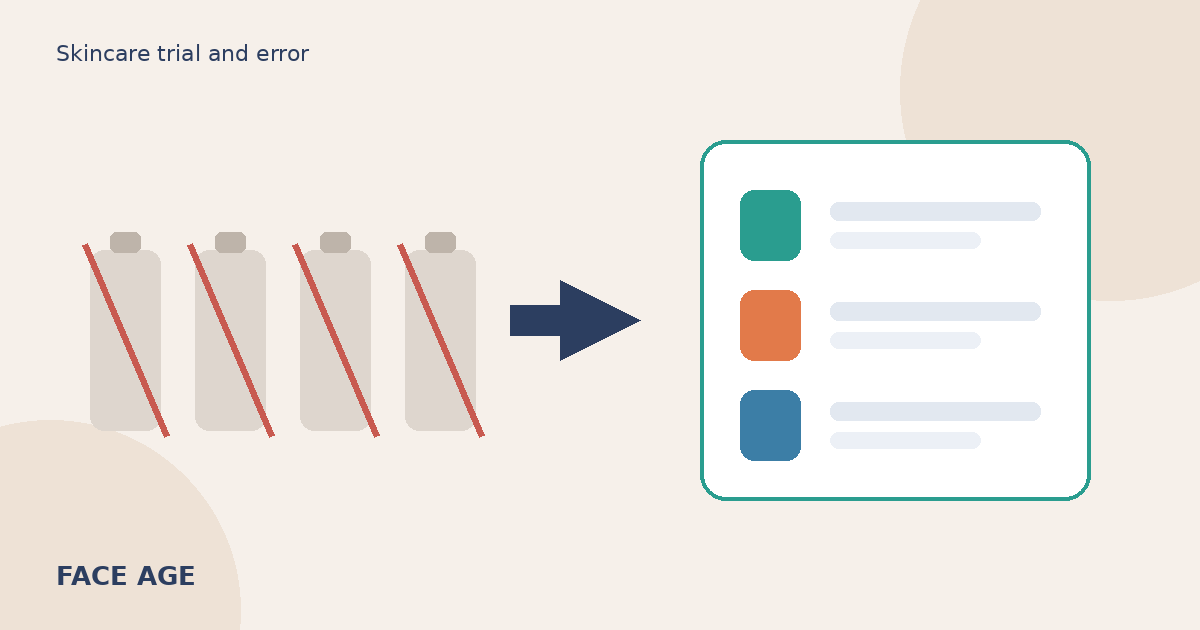
Shoppers type this question into search bars and AI assistants in almost exactly those words: can AI analysis reduce trial-and-error so I waste less money? It's a fair question. Most people who buy skincare online have a drawer of half-used bottles that seemed right on the product page. As a store owner, you can genuinely help with that. You just shouldn't oversell it.
Key terms
- Trial and error: buying a product, waiting to see if it suits you, and starting over when it doesn't.
- Visible concern: something the scan can see in a photo, like pores, redness, dryness or dark circles.
- Severity: the level the analysis assigns to each concern (low, medium, high).
- Exclusion rule: a quiz-based rule that hides a product, for example a strong exfoliant for sensitive skin.
- Comparison: a side-by-side of two scans with each concern marked Improved, Regressed or Stable (Plus and above).
Where skincare trial and error actually comes from
When I talk to store owners about returns and "this didn't work for me" emails, the same patterns come up:
- The shopper guessed their skin type. Lots of people think they're "combination" because it sounds safe.
- They bought for a concern that wasn't their main one, because a friend or an ad mentioned it.
- They stacked too many new products at once, so they couldn't tell what caused what.
- They didn't know a product was strong, and their skin didn't like it.
A product page can't fix any of those. A scan plus a short quiz can address the first, second and fourth reasonably well. The third is a habit, and good routine copy helps with it.
What a scan narrows down
Face Age analyzes one selfie for 13 visible concerns, with severity levels and badges such as Skin Age and Skin Health. Not a medical diagnosis; does not replace a dermatologist.
That replaces the guesswork step. Instead of "I think I have dry skin," the shopper sees which concerns read higher than others in their photo. Your product mapping then does the narrowing: products linked to medium or high dryness show up for someone whose scan shows medium dryness, and products for concerns that read low don't crowd the list. The recommendations feature page shows how that looks on screen.
What a scan can't know
Be upfront about this, on the page and in your own head:
| The scan can see | The scan can't know |
|---|---|
| Visible concerns in this photo, by level | Allergies or ingredient sensitivities |
| Which concerns stand out most | How products felt on this person before |
| A Skin Age estimate | Budget, texture preferences, fragrance dislikes |
| Whether the photo was usable | How skin will respond to a specific formula |
The right-hand column is why a short quiz belongs next to the scan. Two or three questions about sensitivity and past reactions let you set exclusion rules. In Face Age, exclusions always win over the scan, so a shopper who says their skin reacts easily won't see a strong acid just because their pores read high. Our post on how AI skin analysis picks products explains that priority order.
How to set your store up for less guesswork
Here's a setup that targets trial and error directly, on Shopify:
- Map products tightly. In Connect Products, link each product only to the concerns and severity levels it really suits. If every product is linked to every concern, the scan narrows nothing.
- Add a sensitivity question and exclusions. Hide strong exfoliants, retinoid-style products and high-strength acids for "reacts easily" answers.
- Limit the list. In Customization > Basic, set total and per-concern product limits. Three good products beat twelve possible ones.
- Turn on routines (Plus). A morning and night routine built from mapped products tells the shopper the order and which steps matter, which discourages stacking five new things at once. See the AI skincare routine generator guide.
- Switch off concerns you don't sell for. An empty category after a scan is its own kind of trial and error.
Use the second scan to close the loop
Trial and error is partly about not knowing whether something is working. On Plus and above, Face Age can keep analysis history (in the browser, through the server, or both) and show a Compare tab. A returning shopper picks an earlier scan and sees each concern marked Improved, Regressed or Stable.
That gives a structured check-in instead of squinting in the mirror. It doesn't prove a product caused a change, since light, season and sleep all play a part, so frame it as "here's what reads differently since last time." Our walkthrough on reading a before-and-after skin comparison has wording you can borrow.
How to word it on your store
What you can fairly say:
- "Start with products matched to what your scan found."
- "A short list built for your visible concerns, not a guess."
- "Scan again later to see what reads differently."
What to avoid:
- Any promise of saving money, fewer returns or guaranteed results.
- Anything suggesting the scan knows how a formula will work on their skin.
- Medical words. Use "analyze," keep the disclaimer near the result, and don't imply the scan replaces professional advice.
Honest copy here isn't just about compliance. Shoppers who were burned by overpromising product pages are exactly the people asking this question, and they notice the difference.
Where the quiz and the scan disagree
Sometimes a shopper answers "dry" in the quiz and the scan reads oiliness higher than dryness. That's not a bug; people describe how skin feels, and a photo shows how it looks right now. Don't hide either signal. Let quiz answers drive exclusions and preferences, and let the scan drive which concerns get products. If the two clash on something that matters, like sensitivity, the exclusion should win, and in Face Age it does.
You can also use the gap in follow-up. A post-scan email that says "your scan showed some shine on the T-zone, here's a lighter moisturizer to try" respects both what the shopper said and what the photo showed.
Which plan covers this?
Product recommendations and the quiz are on every Face Age Shopify plan, starting with Start at $59 per month. Routines, history, comparison and PDF reports start on Plus at $129. Growth is $249 and Scale is $499. Full details on the pricing page.
FAQ
Can AI skin analysis reduce skincare trial and error? It can narrow the starting point by showing which visible concerns stand out. It can't predict how skin will respond to a specific product.
What can't a photo-based scan know? Allergies, sensitivities, past reactions and unshared goals. A short quiz covers some of that.
Should a store promise fewer wasted purchases? No. Promise a clearer starting point, not savings or results.
How does scan history help? On Plus and above, shoppers can compare scans with each concern marked Improved, Regressed or Stable.
Is the scan a medical assessment? No. Not a medical diagnosis; does not replace a dermatologist.