An AI beauty consultant is better at speed, consistency and being there whenever a shopper is. A human beauty consultant is better at listening, reassurance and judgment calls. For a skincare store the useful question isn't which one wins, it's which part of the consultation each should own. In Face Age, the AI part is a photo-based skin scan plus a quiz that turns into products from your own catalog.
I've watched both kinds of consultation fail in predictable ways. The AI version fails when people use it as an oracle. The human version fails when the person is rushed, new, or simply not there at 11 p.m. on a Sunday. Here's how I'd split the work.
Key terms
- AI beauty consultant: software that analyzes a shopper's photo and answers to suggest products and routines.
- Human beauty consultant: a trained advisor, at a counter, on chat or on a video call.
- Virtual consultation: any consultation that happens online, whether run by software, a person or both.
- Skin concern: a visible topic the scan reads, such as pores, redness, pigmentation or wrinkles.
- Hand-off: the moment a shopper moves from the automated flow to a person.
The scan described in this post is a cosmetic analysis for shopping guidance. Not a medical diagnosis; does not replace a dermatologist.
AI vs human beauty consultants: a side-by-side
| AI beauty consultant | Human beauty consultant | |
|---|---|---|
| Availability | Any hour, any number of shoppers at once | Store hours or chat hours, one at a time |
| Consistency | Same photo, same settings, same read | Depends on the person, the day and their training |
| What it sees | Visible concerns in a photo, plus quiz answers | The face in real light, texture, plus the whole conversation |
| Listening | Only what the quiz asks | Picks up hesitation, budget, past bad reactions |
| Product knowledge | Exactly the mapping you set up, nothing more | Can explain texture, scent, how layers feel |
| Memory | Saved history and two-scan comparison (Plus and above) | Notes, if your team keeps them |
| Cost to scale | A plan fee | Wages, training, scheduling |
None of that table is a score. It's a list of jobs.
Where an AI consultant earns its place
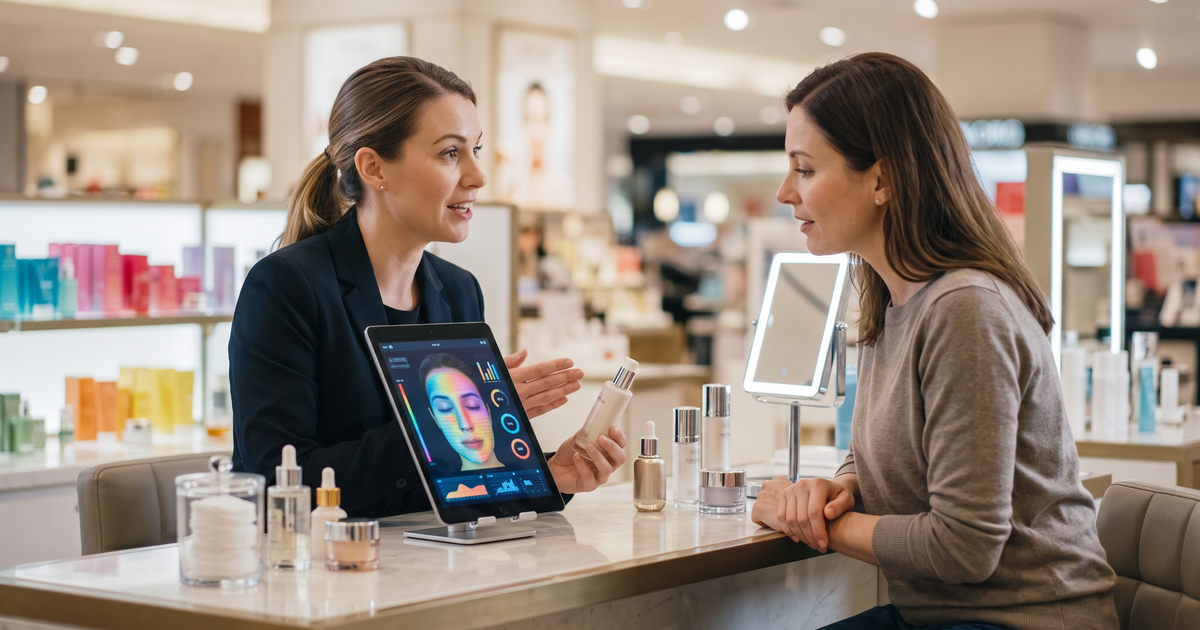
The first read. Most shoppers start with "what's going on with my skin?" A scan answers that in a minute, shows severity per concern and gives a shortlist. That gets someone from 400 products to four.
Repeatability. A human advisor might call the same cheek "a bit oily" on Monday and "combination" on Friday. The scan reads the same way each time, which matters a lot when shoppers come back. Our post on AI skin analysis accuracy covers how to test that yourself before you trust it.
After hours. Online stores get a lot of traffic when no one is on chat. The scan doesn't sleep.
Something to keep. A result the shopper can come back to, or a branded PDF they can download, outlasts any counter chat.
Where a person is still better
Worries. "I reacted badly to my last serum" is not a quiz answer. It's a conversation, and a good advisor will slow down, ask what was in it and steer away from similar actives.
Texture and feel. Software can't tell someone how a balm melts or whether a sunscreen pills under makeup. People who've used the products can.
Edge cases. Very sensitive skin, a visible concern that looks unusual, a shopper who mentions a medical condition. A person should step in and, where it fits, suggest seeing a dermatologist. A scan should never be the last word there.
Trust in premium settings. In a luxury store the human touch is part of what people pay for. We wrote about keeping that feel in AI skin analysis for luxury skincare stores.
Virtual vs in-store beauty consultations
In-store, the human advisor has real light, testers and time. Online, the shopper has privacy, no pressure and a result they can scroll back through. Neither is a cheaper copy of the other.
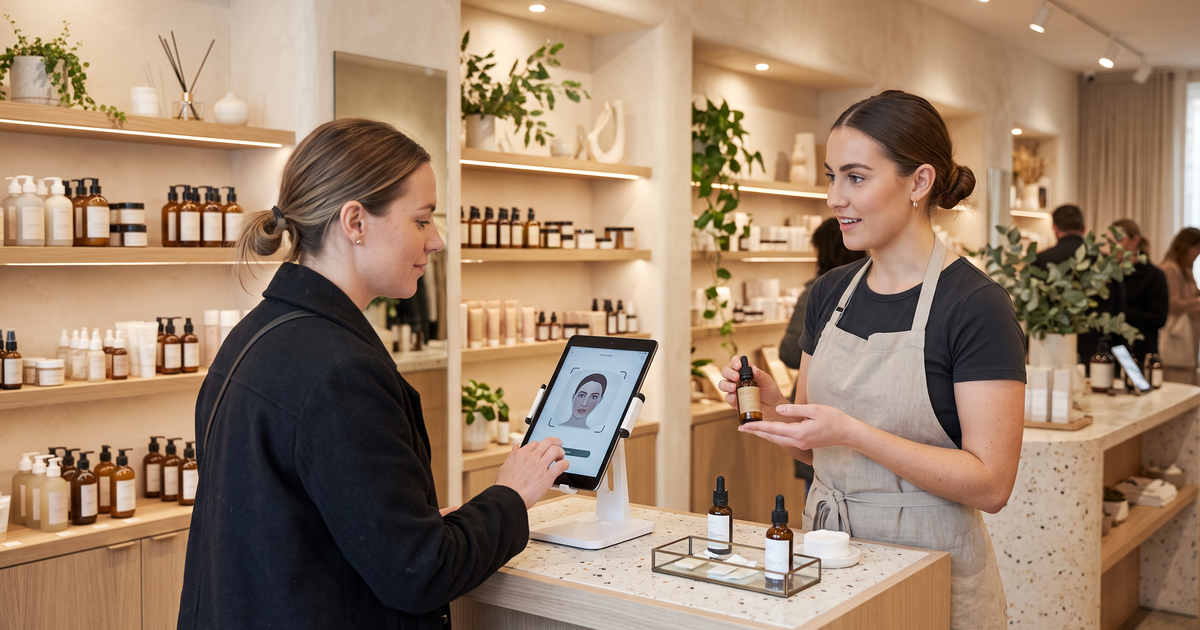
If you run both, the scan can bridge them. A tablet at the counter runs the same analysis as your website, so a shopper who scanned at home can be picked up where they left off. The practical setup for that, including a shared store tablet, is in running an online skin scan in-store and online. For how the tech behaves at a counter, see how skin analysis technology works in a retail beauty setting.
A hybrid flow that works
Here's the flow I'd set up for a small online skincare store with a chat or email team.
- Scan and quiz first. Put the scan on its own page and in a pop-up. Ask two or three quiz questions a photo can't answer, like sensitivity and routine length.
- Show a short product list. Two or three products per result. Long lists send shoppers back to browsing.
- Offer the hand-off on the result. A line like "Questions about this routine? Our team reads every message" with a link to chat or email.
- Give your team the same view. Turn on history with server storage so returning shoppers and your team have the record. The PDF report gives both sides one page to talk about.
- Let people handle the "no". If someone pushes back on a recommendation, a person should answer, not a second scan.
The virtual skin consultation guide goes deeper on the scan-quiz-products sequence, and the consultation solution page shows how Face Age packages it.
What not to promise
Don't call the scan a "skin expert" or say it's "as good as a dermatologist". It isn't, and shoppers notice the overreach. Describe it as a quick analysis that helps pick products. Equally, don't tell your human team the scan is wrong whenever they disagree with it. When they do, look at the photo. Often the light was bad.
Where this is heading
AI consultants will get more conversational, and more shoppers will arrive having already asked a chatbot about their skin. That makes the human part more valuable, not less, because the questions that reach a person will be the harder ones. The wider picture is in our roundup of the latest trends in skin analysis technology.
You can try the analysis side on the AI skin analysis page.
FAQ
Can an AI beauty consultant replace a human one? Not fully. It's faster and more consistent; a person is better at listening and judgment. Use both.
What does an AI beauty consultant actually look at? In Face Age, 13 visible concerns from one photo plus your quiz answers. Not a medical diagnosis; does not replace a dermatologist.
Is a virtual consultation worse than an in-store one? It's different: in-store wins on touch and conversation, online on availability and a result to keep.
How do I combine AI and human consultations? Scan first, then hand questions and sensitive cases to a person, using the saved result as the shared start.